
Why HDPE Ground Protection Mats Flex Without Cracking
2026-05-26 · SIGMA Technical Team
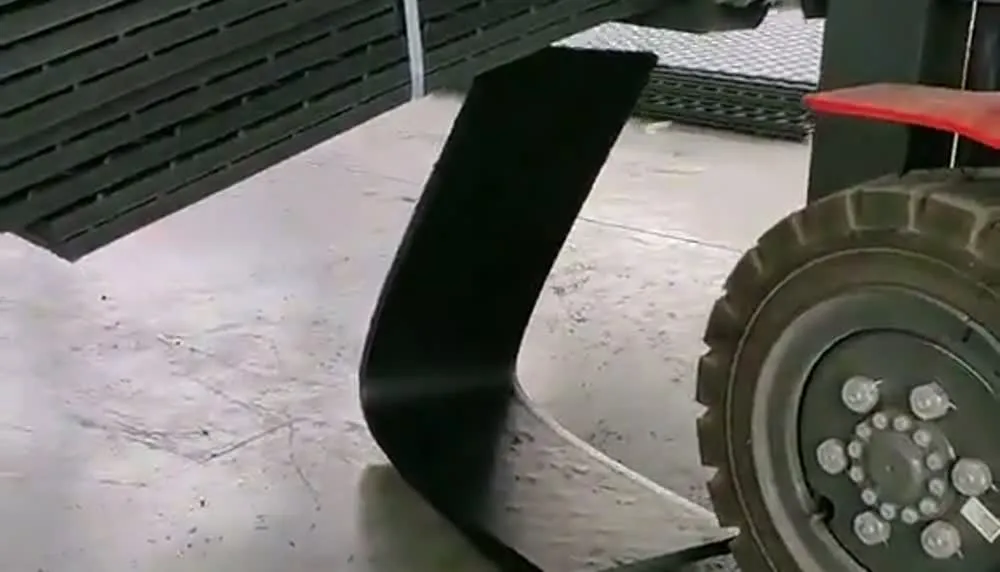
Lift one HDPE ground protection mat by an edge and it folds into a deep curve, then springs back flat — no cracks, no splinters. Here is why that flex matters on site, and where it stops.
Pick one up by the edge
Lift a single HDPE ground protection mat by one end — the way the forklift does in the clip above — and it folds into a deep U, hangs there under its own weight, then drops back dead flat when you set it down. A steel plate would not move; plywood would crease and start to splinter at the fold. That bend-and-recover is not a party trick. It is the main reason HDPE has taken over temporary access work, and it is worth understanding what is actually going on in the material.
Why it bends instead of breaking
HDPE is a semi-crystalline thermoplastic, so under load its molecular chains slide and stretch rather than locking up and fracturing. That gives the mat a flexible body that follows the load instead of resisting it to the point of failure. Catch a steel plate on a hard edge and you can crack a weld; timber splits along the grain. An HDPE panel takes the same knock, flexes, and carries on — and there is nothing in it to rust, rot, or delaminate, which is half the reason crews move off steel plates, plywood, and timber in the first place.
The cold is where it really shows
Plenty of materials that bend in a warm yard turn brittle once it gets cold — that is when cheap plastics crack and timber goes hard and splits. Construction-grade HDPE keeps its flex down to about −50 °C and stays workable up to +60 °C, so the panel that curls on a summer afternoon still bends instead of shattering on a frozen morning. That temperature window is exactly why the mats hold up on remote oil and gas sites, where a board that goes brittle in the cold is a board that fails on the first hard frost.
Flex that works for you on the ground
Out on site the give is a feature, not just something to film. A mat that bends a little settles onto humps, ruts, and soft patches instead of bridging them and rocking, so a standard ground protection mat beds down and stays put under traffic. The same flex makes the mats easier to move: carry them on edge, stack them tight, and curl them to fit a truck bed — it is how a full container holds far more matting than the same volume of rigid board.
Flexible is not the same as floppy
There is a limit, and it matters. The flex that lets a mat follow the ground is not the same as letting it sag under a wheel. Put a loaded truck or a tracked excavator on it and you do not want the panel to flex too far and dish into a rut — there you step up to a heavier section that spreads the load and stays flatter. Matching the give of the mat to the weight on it is the whole point of ground protection mat load ratings: enough flex to seat on the ground, enough stiffness to carry what crosses it.
What the bend buys you
Add it up and the flex is why an HDPE mat lasts. It soaks up the impacts that crack rigid materials, shrugs off the cold that makes them brittle, and bends to fit both the truck and the ground instead of fighting them. That is years of reuse out of one panel instead of a one-job board — the same lifecycle thinking behind choosing the right ground protection mat for the job in front of you.
Need mats for a project like this? Request a quote — we reply within one business day. Or explore the full product range.
Request a QuoteRelated articles
HDPE Mats vs Steel Plates, Plywood, and Timber
Ground protection mats vs plywood, steel plates, and timber: why contractors switch to HDPE — ~95% lighter than steel, reusable for years, non-conductive, rot-proof.
Read → Bog Mats vs Access Mats: What’s the Difference?
Bog mats vs access mats: when you need a large-format bog mat and when a standard access mat will do.
Read →
Recycled vs Virgin HDPE for Ground Mats
Recycled vs virgin HDPE mats: how they compare on cost, colour, UV stability, and sustainability — and which to buy for your job.
Read →